The White Coat Still Matters: Building Trust in the Age of the Wellness Influencer
I recently had the privilege of participating in a session of the American College of Healthcare Executives (ACHE) Executive Program. As healthcare leaders from across the country gathered to discuss the future of healthcare, a recurring theme emerged: How do healthcare organizations remain relevant in a rapidly changing environment? More specifically, how do we connect with patients where they are?
The question is an important one.
Today's patients consume information differently than any previous generation. They are turning to social media, podcasts, YouTube channels, and wellness influencers for guidance on everything from nutrition and hormones to chronic disease management and longevity. The traditional physician-patient relationship now competes with a constant stream of health-related content delivered directly to smartphones.
Many healthcare leaders see this reality and conclude that providers must adapt by becoming more like the influencers who are capturing the public's attention.
I believe that conclusion deserves closer examination.
Healthcare providers absolutely must meet patients where they are. We should communicate more effectively, embrace new channels, and make medical knowledge more accessible than ever before. But in our efforts to connect with patients, we should be careful not to abandon the very qualities that make physicians uniquely trustworthy.
The challenge is not whether physicians should become more approachable.
The challenge is how to remain approachable without surrendering professional authority.
A Crisis of Information, Not a Crisis of Expertise
Healthcare is facing a trust challenge, but it is not because expertise has become less valuable.
If anything, expertise has become more important.
Patients today are inundated with health information. Every day they encounter claims about supplements, diets, biohacking techniques, hormone therapies, longevity protocols, and miracle cures. Some of this information is helpful. Much of it is incomplete, oversimplified, or simply wrong.
The sheer volume of health-related content has created a paradox. Patients have access to more information than ever before, yet many struggle to determine what information is credible.
This is where physicians and healthcare organizations should shine.
Yet many organizations seem to be responding by attempting to mimic the very influencers who have contributed to the noise. Physicians are encouraged to become content creators. Health systems invest heavily in social media strategies designed to appear more casual, more relatable, and more influencer-like.
While these efforts are well intentioned, they risk undermining the very distinction that patients desperately need.
Authority Is Not the Enemy of Trust
Somewhere along the way, healthcare began confusing authority with authoritarianism.
Patients do not want authoritarian providers who dismiss questions, discourage dialogue, or expect blind obedience.
But neither do they want physicians who appear to be merely one opinion among many.
There is a profound difference between being authoritative and being authoritarian.
Authoritative physicians earn trust through competence, humility, experience, and evidence-based judgment. They welcome questions. They explain complex concepts. They engage patients as partners in care.
Authoritarian physicians demand compliance.
Patients rightly reject the latter.
Unfortunately, some healthcare leaders have responded by moving too far in the opposite direction. In an effort to appear approachable, they risk diminishing the signals of expertise that help patients identify trustworthy sources of information.
Patients seek physicians because they want access to knowledge they do not possess. They want guidance through uncertainty. They want someone who has dedicated years of training to understanding the complexities of the human body and the science of medicine.
That authority is not a liability.
It is one of healthcare's greatest assets.
The Influencer Trap
The wellness influencer economy thrives on accessibility, personality, and certainty.
Medicine often requires something different.
Good physicians frequently deliver answers that begin with phrases such as:
"It depends."
"We need more information."
"The evidence is mixed."
"There are risks and benefits to consider."
These answers rarely perform well on social media.
They lack the simplicity and certainty that drive engagement.
But they reflect something critically important: intellectual honesty.
Medicine is nuanced. Human beings are complex. Responsible clinical decision-making requires context, judgment, and a willingness to acknowledge uncertainty.
Influencers are rewarded for confidence.
Physicians are accountable for outcomes.
Those are fundamentally different roles.
When physicians attempt to adopt the same communication style, branding, and tactics as influencers, they risk blurring the distinction between evidence-based expertise and personal opinion.
Patients begin to view every voice as equally qualified.
The board-certified physician with decades of clinical experience becomes just another content creator competing against someone whose primary credential is a large following.
That is not a competition healthcare should want to enter.
Influencers will almost always be better at being influencers.
Physicians should focus on being physicians.
The Signals of Trust Matter
Trust is built on two foundations: competence and character.
Patients want to know that their provider cares about them. They also want confidence that their provider knows what they are doing.
Modern healthcare has rightly emphasized empathy, communication, and patient experience. These are essential components of trust.
However, we should be careful not to neglect competence.
Patients look for signals that indicate expertise. They notice professional appearance. They notice confidence grounded in knowledge. They notice whether recommendations are evidence-based and thoughtfully explained.
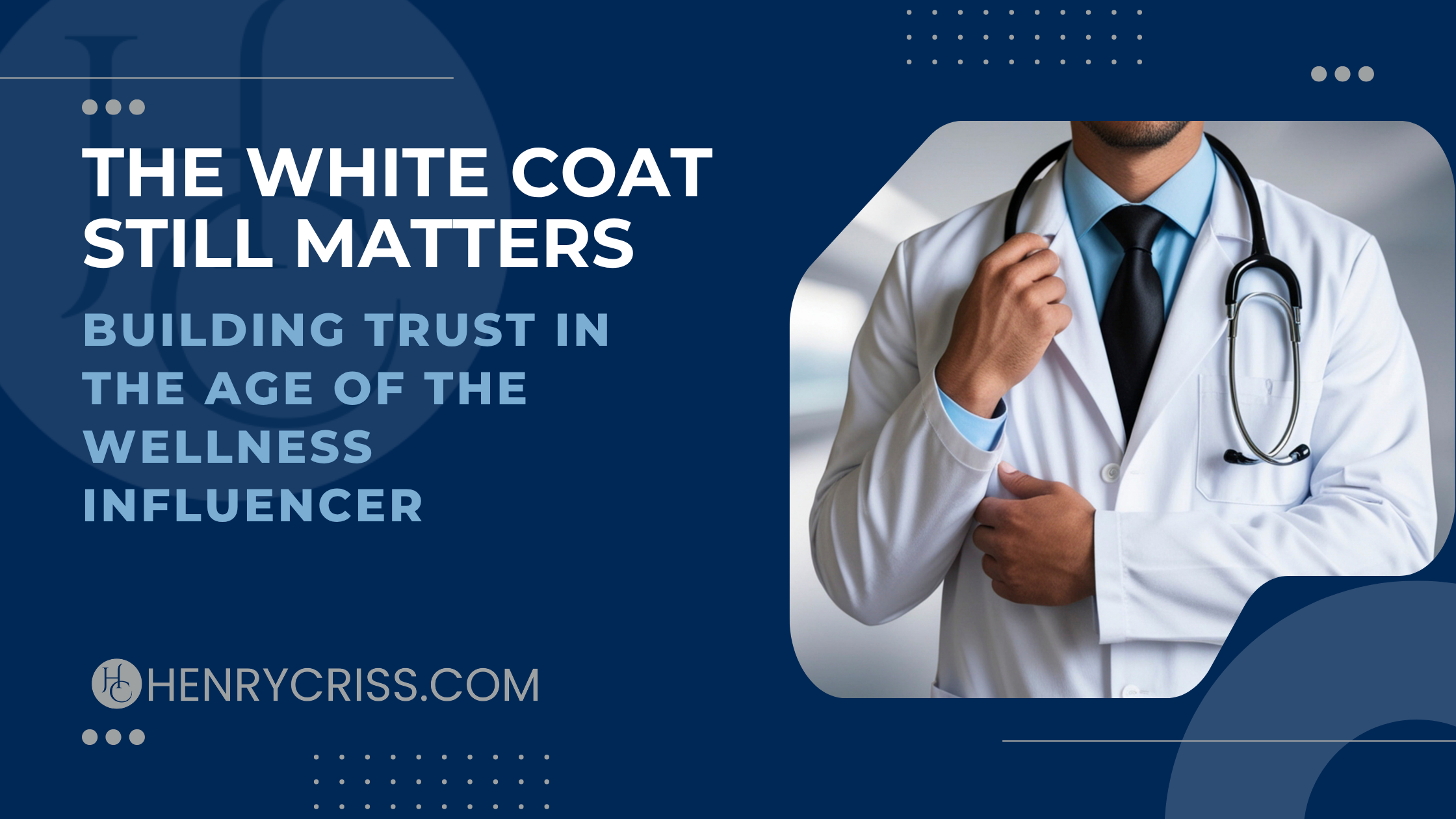
The white coat itself is not magical.
But what it symbolizes matters.
It represents years of education, rigorous training, professional accountability, ethical standards, and a commitment to lifelong learning.
In an era where virtually anyone can create a health-related social media account, those symbols become increasingly important.
Patients should never have to wonder whether their physician's recommendations are rooted in science or social media trends.
Lessons from Other Professions
Consider the professionals we trust in other high-stakes environments.
When we board an airplane, we want a pilot who communicates clearly and calmly. We do not need the pilot to resemble a travel influencer.
When we appear before a judge, we expect fairness, professionalism, and expertise. We do not expect the judge to cultivate a social media personality.
When military leaders are responsible for the lives of those under their command, we value competence, discipline, and sound judgment over popularity.
In each case, trust is strengthened—not weakened—by visible professionalism and demonstrated expertise.
Healthcare should be no different.
Patients want their physicians to be human. They want warmth, empathy, and accessibility.
But they also want confidence that the person guiding their care possesses a level of expertise that cannot be replicated through internet searches and social media algorithms.
A Better Path Forward
The solution is not to retreat behind institutional walls or return to the paternalistic models of the past.
Healthcare providers must absolutely meet patients where they are.
We should embrace digital communication.
We should participate in social media.
We should educate through podcasts, videos, newsletters, and online platforms.
We should make medical information more understandable and more accessible than ever before.
But we should do so without sacrificing professional identity.
Healthcare organizations should encourage physicians to communicate like trusted experts, not influencers.
That means:
Being accessible without becoming casual.
Being relatable without abandoning professionalism.
Using social media without adopting influencer culture.
Simplifying information without oversimplifying science.
Demonstrating empathy while maintaining authority.
Building personal connections without diluting expertise.
The goal should not be to become indistinguishable from the voices competing for attention online.
The goal should be to offer something those voices often cannot: trusted expertise grounded in evidence, experience, and accountability.
The Future of Trust
As I reflected on the conversations during the ACHE Executive Program, I became increasingly convinced that healthcare's future relevance will not be determined by our ability to imitate influencers.
It will be determined by our ability to communicate expertise in ways that patients can understand and trust.
Healthcare leaders are right to ask how we can meet patients where they are. We must embrace new technologies, new communication channels, and new ways of engaging our communities.
But we should not confuse accessibility with equivalence.
The answer is not for physicians to become influencers.
The answer is for physicians to become better communicators while remaining unmistakably physicians.
In a world overflowing with opinions, patients still need experts.
They still need professionals who have devoted years to mastering their craft. They still need guides who can help them navigate uncertainty with evidence, experience, and judgment.
The future of healthcare trust will belong to organizations and providers who can combine humanity with expertise, empathy with competence, and accessibility with authority.
Because in the end, patients do not need another influencer.
They need someone they can trust.