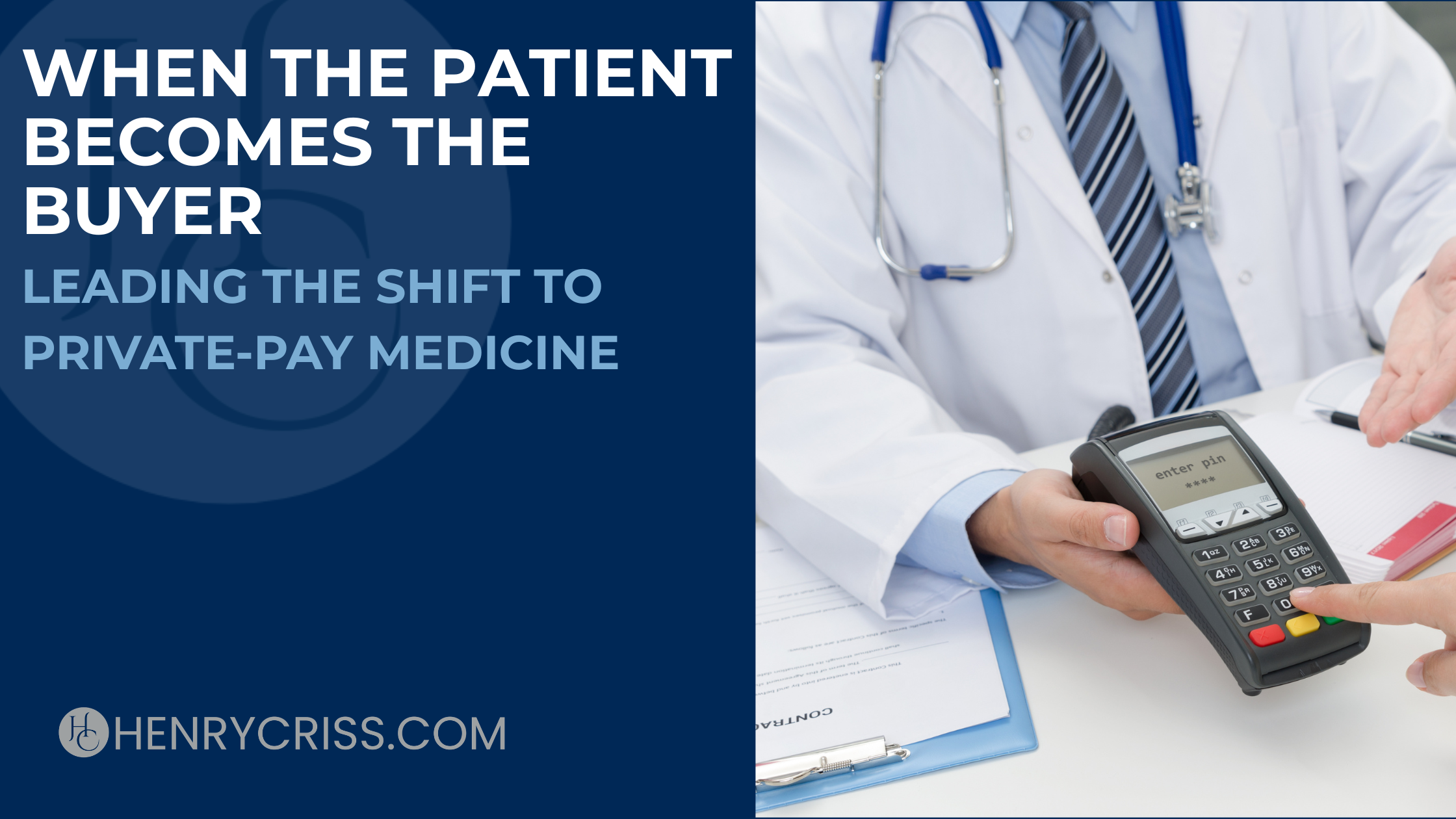
For decades, much of American healthcare has operated within an unusual economic relationship: the person receiving the service is often not the person directly purchasing it. Patients choose physicians and receive care, but insurance companies and government payers largely determine what services are covered, what providers will be paid, and how much of the cost ultimately reaches the patient. As a result, both clinicians and patients have learned to operate within a system where the traditional relationship between buyer, seller, price, and value is often obscured.
Private-pay medicine changes that relationship. When patients are spending their own money, they gain something that has historically been diluted in much of healthcare: real purchasing power. They can ask what something costs, compare alternatives, evaluate whether the expected benefit justifies the expense, and ultimately decide not to buy. For healthcare executive leaders, that change is much more significant than replacing insurance reimbursement with private payment. It requires a different operating model, a different organizational culture, and, perhaps most importantly, a different mindset from both clinicians and patients.
From Beneficiary to Consumer
Traditional healthcare has conditioned patients to ask, “Does my insurance cover this?” or “What is my copay?” Those are perfectly rational questions within an insurance-based system, but they are very different from the questions consumers ask when spending their own money. In a private-pay model, the questions become: What will this cost me? What am I getting for that investment? What are my alternatives? What should I reasonably expect from treatment? Is this worth it to me?
That last question is particularly important. In a private-pay environment, a clinically appropriate recommendation does not automatically translate into a purchasing decision. A patient may understand the recommendation, agree that it could benefit them, and still decide that the expected value does not justify the expense. Healthcare organizations have to be comfortable with that because consumer choice necessarily includes the choice to say no.
This creates a different challenge for clinicians as well. Clinical training appropriately emphasizes diagnosis, clinical judgment, treatment recommendations, informed consent, and patient outcomes. It generally spends far less time teaching clinicians how to communicate value or discuss substantial out-of-pocket costs. Yet those conversations are unavoidable in private-pay medicine. When a patient is being asked to personally spend hundreds or thousands of dollars, it is reasonable for them to want to understand why a particular treatment is being recommended, what alternatives exist, what benefits and limitations they should realistically expect, what happens if they choose not to proceed, and why the service costs what it does.
Answering those questions well does not mean turning clinicians into salespeople. It means giving patients enough information to make an informed decision about both their health and their money. That distinction matters.
The Uncomfortable Question of “Sales”
Healthcare leaders are often uncomfortable with the word “sales,” and there are good reasons for that discomfort. Medicine depends on trust. Patients should never have to wonder whether a recommendation is being made because it is clinically appropriate or because someone is trying to hit a revenue target. At the same time, pretending that no commercial transaction exists does not make the financial component disappear.
Private-pay healthcare involves an exchange of value. A service is being offered at a price, and a patient is deciding whether to purchase it. The leadership challenge is to build an organization where that reality can be acknowledged without allowing financial incentives to compromise clinical judgment.
That requires clear roles. The clinician's responsibility is to make an appropriate recommendation, explain the reasoning behind it, discuss alternatives, and communicate realistic expectations. The organization's responsibility is to make pricing transparent, explain financial options, remove unnecessary friction, and ensure the patient understands what is being offered. The patient's responsibility is to decide whether to proceed. Maintaining those distinctions protects clinical trust while respecting patient autonomy.
Private pay also exposes weak value propositions much faster than traditional reimbursement models. When payment is mediated through insurance, the relationship between the price of a service and the patient's perception of its value can be difficult to see. Charges, negotiated rates, deductibles, copays, contractual adjustments, and third-party payments all create distance between the service delivered and the money ultimately received. Private pay removes much of that distance. When someone is personally considering spending $500, $2,500, or $10,000, the question of value becomes immediate.
That does not mean healthcare should be treated like ordinary retail. Healthcare decisions carry clinical, ethical, and emotional considerations that distinguish them from most consumer purchases. But it does mean that organizations have to earn the patient's decision. Credentials, technology, clinical expertise, convenience, service, and outcomes can all contribute to value, but none of them automatically creates it. Ultimately, value is experienced and judged by the patient.
The Executive's Role
This is where healthcare executive leadership becomes especially important. Moving into private pay cannot simply mean removing insurance billing and installing a credit-card terminal. The organization has to be redesigned around a fundamentally different economic relationship.
Pricing needs to be understandable and consistent. Services need to be clearly defined. Clinicians need training on discussing value and cost without feeling that they are being asked to sell treatment. Staff members need to understand their roles in the financial conversation, and patient education needs to happen before the purchasing decision rather than after it. The patient experience also has to match the expectations created by asking someone to spend their own money.
Leaders also need to rethink what they measure. Revenue matters, but it cannot be the only indicator of success. Patient experience, clinical outcomes, retention, complaints, refunds, service recovery, treatment acceptance, and the reasons patients decline recommendations can all reveal whether the organization's value proposition is actually working. A patient who declines care is not necessarily a failed conversion. Sometimes it is evidence that the system worked exactly as it should: the patient received enough information to make an informed decision and chose not to proceed.
Compensation deserves particular scrutiny as well. If leadership tells clinicians to put patients' interests first while simultaneously creating aggressive financial incentives tied to high-dollar treatment acceptance, the organization creates tension between its stated values and its operating system. Culture follows incentives, and healthcare executives need to be deliberate about what behaviors their compensation structures actually encourage.
Patients need support through this transition too. Many have spent their entire lives navigating healthcare through insurance and may associate “not covered by insurance” with “not medically legitimate.” Others may assume that paying more guarantees a better result. Neither assumption is necessarily true. Private-pay organizations therefore have an obligation to clearly communicate what is being recommended, why it is being recommended, what evidence supports it, what alternatives exist, what outcomes are realistic, and what cannot be promised. Transparency in this environment is more than good customer service. It is fundamental to trust.
Ultimately, the greatest challenge in moving toward private-pay medicine may not be pricing, marketing, billing, or patient acquisition. It is culture. Clinicians have to become comfortable discussing money while maintaining clinical integrity. Staff members have to recognize that financial conversations are part of the patient experience. Patients have to become comfortable exercising greater purchasing power and asking harder questions about price and value. And healthcare executives have to build systems where clinical appropriateness, transparency, consumer choice, and financial sustainability reinforce one another rather than compete.
Private-pay medicine changes who writes the check, but the more consequential change is who makes the buying decision. When the patient becomes the buyer, healthcare organizations have to earn that decision. Our responsibility as healthcare leaders is to build systems that allow patients to make it confidently and transparently, without compromising the clinical trust at the center of medicine.